
Risk Transfer and Distribution
A fundamental component of every insurance policy is Risk Transfer & Distribution.
Risk transfer and distribution are easily understood as a consumer enters an agreement to pay premium each month or annually to their insurance provider covering their automobiles. If or when their car is in an accident and a claim is made, the insurance company pays out not directly from the insureds own reserve, but from a general account of thousands of insureds. All individuals paying premiums to the carrier are contributing to the claim. Each insured individual may insure different automobiles, different deductibles if any, and the premiums vary based on the vast variables of the cars being insured such as age, mileage, make, condition, quantity, and value as well as the insureds variables such as age, driving history, location, etc.
In specific insurance language, risk-transfer involves the transfer of the impact of a potential economic loss from the insured to the insurer through a contractual agreement. Risk transfer occurs if a person facing the possibility of an economic loss transfers some or all of the financial consequences of the potential loss to the insurer, such that a loss to the insured does not affect the insured because the loss is offset by the insurance payment.
Risk-distribution means that a party assuming the risk distributes his potential liability, in part, among others. Risk distribution necessarily entails a pooling of premiums, so that a potential insured is not in significant part paying for its own risks.
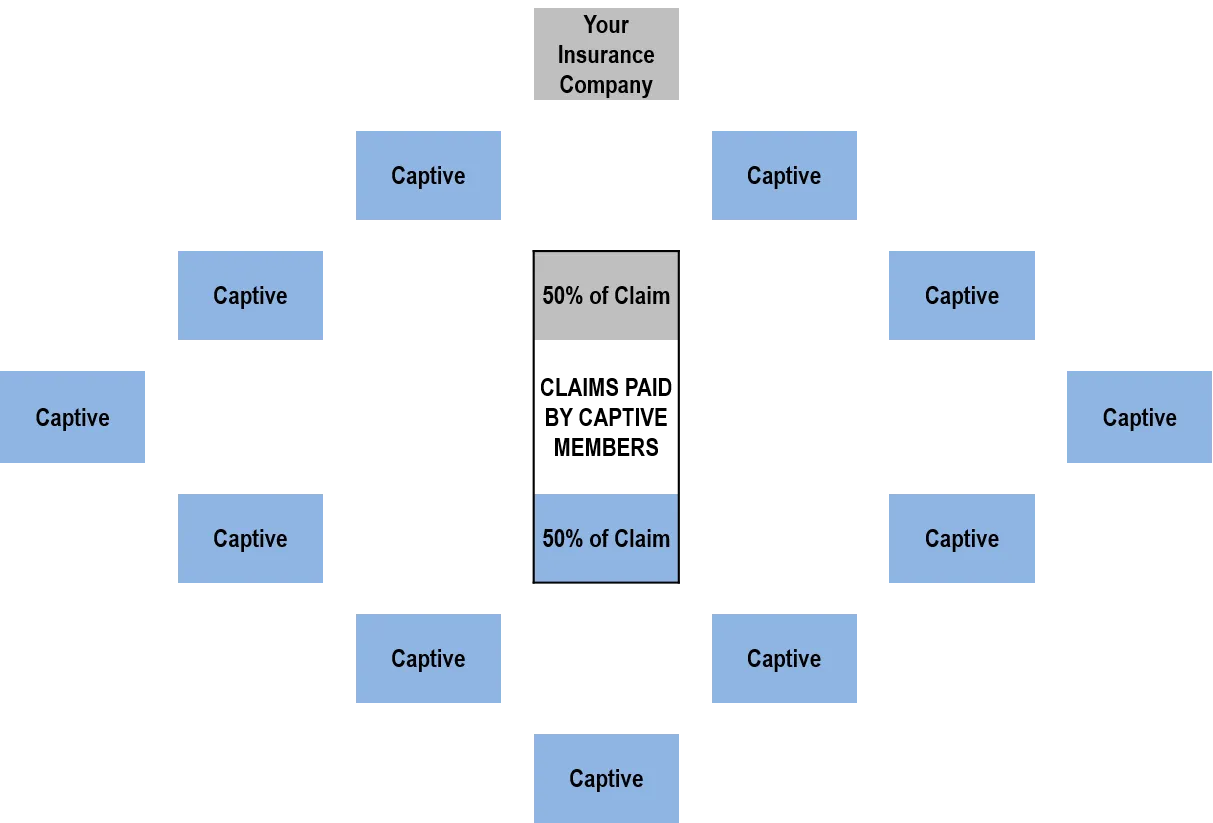
Properly structured Captive Insurance companies meet the same risk transfer and distribution insurance requirements. Similar to automobile exposures, each business exposures vary on premiums, policy limits (both per occurrence as well as annual aggregate limits), and value. Despite the unique operation, geographic location, and coverages insured by individual companies, risk transfer and distribution is formed by combining these businesses in a risk pool of companies. Ultimately, as a whole, these companies provide reinsurance for one another.
These key factors, risk-transfer and risk-distribution, have been identified as elements necessary for proper Captive Insurance structure. Again, risk-transfer means one party shifts risk of loss to another party, and risk-distribution means that the party assuming the risk distributes potential liability, in part, among others.
Claims are paid "quota share" which means the company making the claim will pay 50% of a given claim from their insurance company, and the remaining 50% of the claim will be paid on a pro-rata basis from the other members of the risk pool. Always consider the size of a given risk pool.

First, last and always, Captives provide insurance for a business and the business' owner. And in the process create Your Link to Security!
Your Link to Security!